
Introduction
Every business performs hundreds or thousands of processes every day.
A sales executive follows up with leads.
An HR team manages employee requests.
Operations teams coordinate tasks.
Finance teams process invoices.
Managers review reports.
Customer support teams respond to inquiries.
The problem is that many of these processes still depend heavily on people manually moving information from one place to another.
A person receives an email.
They read it.
They decide what needs to happen.
They open another application.
They enter information.
They notify someone.
Later, someone prepares a report about what happened.
Software has already improved this process significantly, but the next phase of digital transformation is moving beyond simply digitizing work.
Businesses are increasingly moving toward automation, intelligent automation, AI-assisted workflows, and agentic operations.
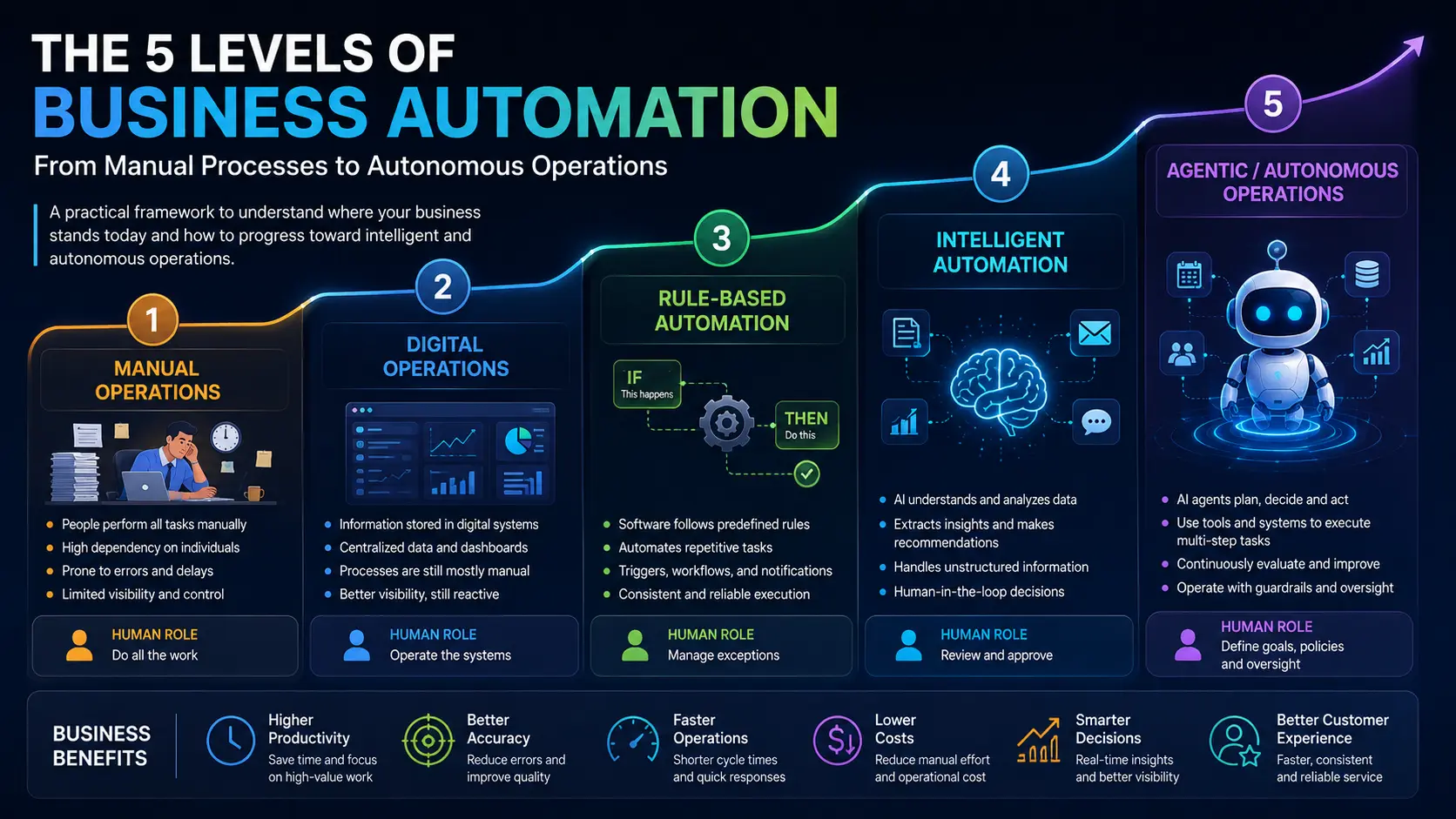
This evolution can be understood through five levels of business automation:
Manual Operations
Digital Operations
Rule-Based Automation
Intelligent Automation
Autonomous / Agentic Operations
Understanding these levels helps businesses determine where they are today, what they should automate next, and where AI can provide genuine operational value.
What Is Business Automation?
Business automation is the use of software, technology, workflows, and increasingly artificial intelligence to perform business processes with less manual intervention.
Automation can involve:
Data entry
Notifications
Approvals
Reporting
Customer communication
Lead management
Employee workflows
Document processing
Scheduling
Data synchronization
Business intelligence
AI-assisted decision-making
Multi-step task execution
But automation is not a single technology.
A simple email notification and an AI agent managing a multi-step sales workflow are both forms of automation, but they represent very different levels of capability.
That is why it is useful to think about automation as a maturity model.
The 5 Levels of Business Automation
A simplified progression looks like this:
LEVEL 1
Manual
   ↓
LEVEL 2
Digital
   ↓
LEVEL 3
Rule-Based Automation
   ↓
LEVEL 4
Intelligent Automation
   ↓
LEVEL 5
Agentic / Autonomous Operations
Each level builds on the previous one.
The objective is not necessarily to reach Level 5 everywhere.
The objective is to use the right level of automation for the right business process.
Level 1 — Manual Operations
People Perform the Work
At Level 1, most business processes are performed manually.
Technology may exist, but people are responsible for moving information and completing the workflow.
A typical process might look like:
Customer Inquiry
      ↓
Employee Reads Message
      ↓
Employee Checks Information
      ↓
Employee Updates Spreadsheet
      ↓
Employee Contacts Customer
      ↓
Employee Updates Another System
      ↓
Manager Receives Report
The software may only be used as a storage mechanism.
The process itself depends on human coordination.
Common Characteristics
Manual organizations often depend on:
Spreadsheets
Email
WhatsApp
Paper documents
Phone calls
Manual reports
Individual employee knowledge
Repetitive data entry
Manual follow-ups
This creates several operational challenges.
Repetitive Work
Employees spend time performing activities that could potentially be automated.
Human Error
Manual data entry and repetitive processing increase the possibility of mistakes.
Limited Visibility
Management may only see the final report rather than the operational activity behind it.
Dependency on Individuals
Important business knowledge may exist primarily in the minds of employees.
Slow Reporting
Information often has to be manually collected before a report can be created.
Example: Manual Sales Process
Imagine a real estate company receiving property inquiries.
A sales executive may need to:
Receive inquiry
Read the message
Record customer information
Identify the customer's requirement
Search available properties
Contact the customer
Record the conversation
Schedule follow-up
Inform the manager
Every step requires human involvement.
This does not necessarily mean the business is inefficient.
But it means there is significant opportunity for improvement.
Level 2 — Digital Operations
Software Stores and Organizes the Work
At Level 2, the organization starts moving its processes into digital systems.
Instead of storing information in notebooks or scattered spreadsheets, businesses introduce:
CRM systems
ERP systems
HRMS
Project management software
Cloud storage
Databases
Business dashboards
Digital forms
The process becomes:
Employee
    ↓
Business Application
    ↓
Database
    ↓
Dashboard / Report
The business is now digital, but much of the work may still be manual.
Digital Does Not Automatically Mean Automated
This distinction is important.
A company can have an ERP, CRM, HRMS, and dozens of software applications and still have highly manual operations.
For example:
An employee enters a lead into a CRM manually.
The information is digital.
But the process is not automated.
Similarly:
A manager opens five dashboards every morning to prepare a report.
The reporting system is digital.
But the reporting process is still manual.
Digital transformation creates the foundation for automation, but digitization and automation are not the same thing.
Example: Digital Sales Process
Instead of maintaining leads in Excel:
Customer
   ↓
CRM
   ↓
Lead Record
   ↓
Sales Executive
The business now has:
Centralized customer information
Lead history
Sales stages
Follow-up records
Searchable data
Reporting capabilities
This is a significant improvement.
But the employee may still need to perform most actions manually.
That leads to Level 3.
Level 3 — Rule-Based Automation
Software Starts Performing the Work
At Level 3, businesses begin automating predictable processes.
The system follows predefined rules.
A typical workflow might be:
Business Event
      ↓
Condition
      ↓
Rule
      ↓
Action
For example:
IF
lead_status = "New"

THEN
assign lead to sales executive
AND
send notification
AND
create follow-up task
This is rule-based automation.
Examples of Rule-Based Automation
Sales
New Lead
 ↓
Assign Salesperson
 ↓
Create Task
 ↓
Send Notification
HR
Employee Joins
 ↓
Create Employee Record
 ↓
Send Onboarding Email
 ↓
Create HR Tasks
Finance
Invoice Overdue
 ↓
Change Status
 ↓
Send Reminder
 ↓
Notify Finance Team
Operations
Task Overdue
 ↓
Change Status
 ↓
Notify Manager
 ↓
Create Escalation
These processes are extremely valuable because they remove repetitive manual work.
Why Rule-Based Automation Is Powerful
Businesses should not underestimate traditional automation.
Rule-based systems have major advantages:
Predictable
Fast
Cost-effective
Easy to test
Easy to audit
Deterministic
Reliable for structured processes
If a process can be expressed clearly as:
When X happens, do Y.
traditional automation is often the best solution.
The problem begins when processes become too complex or require interpretation.
That is where Level 4 becomes important.
Level 4 — Intelligent Automation
AI Starts Understanding the Work
At Level 4, AI is introduced into business workflows.
Instead of relying only on predefined rules, the system can interpret information and provide intelligent recommendations or decisions.
The workflow becomes:
Business Data
      ↓
AI
      ↓
Understand Context
      ↓
Analyze
      ↓
Recommend
      ↓
Human / Workflow
This is often called intelligent automation or AI-assisted automation.
Why AI Changes Automation
Traditional automation works best with structured information.
AI can work with much more complex inputs.
For example:
Emails
Documents
Customer conversations
Images
Voice recordings
Natural language requests
Unstructured text
Consider an incoming email.
A rule-based system might need predefined keywords to determine what the email means.
An AI system can potentially understand the intent.
Incoming Email
      ↓
AI Analysis
      ↓
Identify Intent
      ↓
Extract Information
      ↓
Determine Priority
      ↓
Trigger Workflow
This makes automation more flexible.
Example: Intelligent Sales Automation
Suppose a customer writes:
"I'm looking for a 3-bedroom apartment near the airport with a budget around ₹1.5 crore. I would like to visit this weekend."
A traditional system may simply store the message.
An intelligent system could extract:
Property Type → Apartment
Bedrooms → 3
Location → Near Airport
Budget → ₹1.5 Crore
Intent → Property Purchase
Visit → This Weekend
The system could then:
Find matching properties
Prioritize the lead
Create a CRM record
Prepare a response
Notify a sales executive
Schedule a follow-up
The important difference is that the system understands the information before automating the workflow.
AI-Assisted Decision Making
Level 4 does not necessarily mean AI takes the final action.
Often, AI provides recommendations.
For example:
Sales Data
    ↓
AI Analysis
    ↓
"15 high-value leads require follow-up"
    ↓
Sales Manager
    ↓
Approve / Review
This creates a powerful human + AI model.
The AI handles analysis.
The human handles judgment.
Level 5 — Agentic / Autonomous Operations
AI Starts Executing Multi-Step Work
Level 5 represents the emerging frontier of business automation.
Instead of simply following fixed rules or making recommendations, an AI agent can be given a goal and use authorized tools to accomplish it.
The model becomes:
Business Goal
      ↓
AI Agent
      ↓
Understand
      ↓
Plan
      ↓
Use Tools
      ↓
Execute
      ↓
Evaluate
      ↓
Continue / Escalate
This is commonly described as agentic automation.
What Makes Level 5 Different?
Consider this request from a sales manager:
"Find our high-value opportunities that haven't been followed up recently and prepare a plan for recovering them."
A Level 3 system would need explicit rules.
A Level 4 system might analyze the opportunities and provide recommendations.
A Level 5 agent could potentially:
Query the CRM
Identify high-value opportunities
Review activity history
Determine which opportunities are inactive
Analyze customer context
Prioritize opportunities
Research available internal information
Prepare follow-up strategies
Create CRM tasks
Draft communications
Request approval where required
Update the system
Report the completed work
The agent is no longer simply answering a question.
It is participating in the execution of the business process.
The Five Levels Compared
LevelCapabilityHuman RoleTypical Technology1. ManualPeople perform workVery HighEmail, spreadsheets2. DigitalSoftware stores informationHighCRM, ERP, databases3. Rule-BasedSoftware follows rulesMediumWorkflow engines, triggers4. IntelligentAI understands and recommendsMediumLLMs, AI automation5. AgenticAI plans and executes tasksControlledAI agents, tools, orchestration
The progression is not about eliminating humans.
It is about moving human effort toward higher-value activities.
A Practical Example: From Manual to Agentic
Consider a company's daily management reporting process.
Level 1 — Manual
Employees collect information and prepare the report.
Employees
 ↓
Collect Data
 ↓
Excel
 ↓
Prepare Report
 ↓
Management
Level 2 — Digital
Information is available in business systems.
CRM + ERP + HRMS
        ↓
     Database
        ↓
    Dashboard
Level 3 — Rule-Based
Reports are automatically generated.
Scheduled Event
      ↓
Query Data
      ↓
Generate Report
      ↓
Send Email
Level 4 — Intelligent
AI analyzes the report.
Business Data
      ↓
AI Analysis
      ↓
Identify Trends
      ↓
Highlight Exceptions
      ↓
Management
Level 5 — Agentic
An AI operations agent manages the entire reporting workflow.
Scheduled Event
      ↓
Operations Agent
      ↓
Collect Authorized Data
      ↓
Analyze Performance
      ↓
Identify Exceptions
      ↓
Investigate Relevant Information
      ↓
Generate Management Brief
      ↓
Create Follow-up Tasks
      ↓
Notify Responsible Teams
The final system does much more than generate a report.
It helps operate the process around the report.
Not Every Process Should Reach Level 5
This is one of the most important principles of automation.
Businesses should not attempt to make every process autonomous.
For example:
Payroll Calculation
Traditional deterministic software may be better.
Database Backup
Traditional automation is better.
Invoice Generation
Rule-based automation may be sufficient.
Customer Email Classification
AI may provide significant value.
Sales Lead Qualification
AI-assisted or agentic automation may be valuable.
Strategic Business Decisions
Human judgment should remain central.
The right question is not:
"How much AI can we add?"
It is:
"What level of automation is appropriate for this process?"
How to Decide What to Automate
A practical framework is to evaluate each business process using five questions.
1. Is the Process Repetitive?
If employees perform the same steps every day, automation may provide value.
2. Is the Process Rule-Based?
If the logic is predictable, traditional automation may be sufficient.
3. Does the Process Require Understanding?
If the process involves emails, documents, conversations, or ambiguous information, AI may help.
4. Does the Process Require Multiple Actions?
If the system needs to interact with several applications, an agentic approach may become useful.
5. What Is the Risk of an Incorrect Action?
Low-risk tasks can support greater automation.
High-risk tasks may require human approval.
The Business Automation Maturity Matrix
Businesses can evaluate processes using two dimensions:
Complexity and Risk.
Low Complexity + Low Risk
Use traditional automation.
Examples:
Notifications
Data synchronization
Scheduled reports
High Complexity + Low Risk
Consider AI-assisted or agentic automation.
Examples:
Internal reporting
Lead research
Document classification
Low Complexity + High Risk
Use deterministic software with strong controls.
Examples:
Financial transactions
Permission changes
High Complexity + High Risk
Use AI for assistance but maintain strong human oversight.
Examples:
Strategic decisions
High-value financial actions
Sensitive employee decisions
This approach prevents organizations from adopting AI simply for the sake of adopting AI.
The Technology Behind Modern Automation
A modern automation architecture can contain several layers:
                 Business Users
                       ↓
                Application Layer
                       ↓
              AI / Agent Layer
                       ↓
              Workflow Orchestration
                       ↓
            APIs / Tools / Integrations
                       ↓
       ┌───────────────┼───────────────┐
       ↓               ↓               ↓
      CRM             ERP             HRMS
       ↓               ↓               ↓
                 Business Data
Each layer has a different responsibility.
Business Applications
Manage operational processes.
Workflow Engines
Handle deterministic process execution.
AI Models
Understand and reason about information.
AI Agents
Plan and execute multi-step tasks.
APIs and Tools
Provide controlled access to business capabilities.
Databases
Store operational data.
Observability
Monitors automation and AI behavior.
Where MCP and AI Agent Architecture Fit
As businesses adopt AI agents, integration becomes a major architectural consideration.
An agent needs access to capabilities such as:
CRM
ERP
Databases
Email
Calendar
Documents
Reporting
Internal applications
Protocols such as Model Context Protocol (MCP) can provide a standardized way for AI applications to interact with tools and contextual resources.
A simplified architecture can look like:
AI Agent
   ↓
Agent Orchestration
   ↓
MCP / APIs / Tools
   ↓
Business Applications
   ↓
Enterprise Data
The important concept is that AI should not receive unrestricted access to the entire technology environment.
Capabilities should be exposed through controlled interfaces and appropriate permissions.
The Role of Humans in Automated Businesses
Higher automation does not mean humans disappear.
Instead, the role of humans changes.
At Level 1:
Humans perform the work.
At Level 2:
Humans operate software.
At Level 3:
Humans manage exceptions.
At Level 4:
Humans review AI recommendations.
At Level 5:
Humans define goals, policies, permissions, and strategic decisions while AI handles appropriate operational execution.
This creates a new operating model:
Human
 ↓
Goal + Policy
 ↓
AI / Automation
 ↓
Execution
 ↓
Human Oversight
The objective is not to remove human judgment.
It is to reduce the amount of human attention required for routine work.
Measuring Automation Success
Automation should never be measured only by the number of workflows created.
Businesses should measure actual outcomes.
Productivity
How many hours of manual work were eliminated?
Speed
How much faster does the process complete?
Accuracy
Have errors decreased?
Cost
Has the cost per transaction decreased?
Employee Experience
Are employees spending less time on repetitive work?
Customer Experience
Are response times improving?
Business Impact
Is automation contributing to revenue, retention, operational efficiency, or better decision-making?
A successful automation project should answer:
What business outcome improved because of automation?
Common Mistakes Businesses Make
Automating a Bad Process
If the process is inefficient, simply automating it can make the inefficiency faster.
First improve the process.
Then automate it.
Using AI Where Rules Are Better
If a process is completely deterministic, an AI model may add unnecessary complexity.
Use rules when rules are enough.
Giving AI Too Much Authority
AI agents should have clearly defined permissions.
Do not give an agent unrestricted access simply because the technology makes it possible.
Ignoring Business Data
AI cannot reliably automate processes if the required information is fragmented, inaccurate, or inaccessible.
Automating Without Measurement
If you cannot measure the improvement, it becomes difficult to determine whether automation actually created value.
How a Business Can Progress Through the Five Levels
A practical transformation roadmap might look like:
1. Map Processes
       ↓
2. Digitize Information
       ↓
3. Automate Repetitive Rules
       ↓
4. Introduce AI Intelligence
       ↓
5. Deploy Controlled AI Agents
       ↓
6. Continuously Measure & Improve
Businesses do not need to transform everything at once.
Start with one process.
Measure the result.
Then expand.
The Future: Autonomous Business Operations
The long-term direction of business automation is moving toward systems that can continuously observe business activity, identify required actions, and execute appropriate workflows.
A future operational environment might look like:
                   BUSINESS
                       │
          ┌────────────┼────────────┐
          ↓            ↓            ↓
        Sales          HR        Operations
          │            │            │
          └────────────┼────────────┘
                       ↓
                Business Data
                       ↓
                AI Operations
                     Layer
                       ↓
              Agent Orchestration
                       ↓
             Tools + Workflows
                       ↓
                  Execution
                       ↓
              Monitoring + Audit
                       ↓
                   Humans
Instead of employees constantly checking systems to determine what needs attention, systems can increasingly surface and handle appropriate actions proactively.
That is the direction toward autonomous business operations.
Final Thoughts
Business automation is not a single technology.
It is a progression.
Businesses move from:
Manual work
to
Digital systems
to
Rule-based automation
to
Intelligent automation
to
Agentic operations.
Each level creates new possibilities.
But the objective is not to reach the highest level simply because it exists.
The objective is to create an operating environment where technology handles repetitive work, AI handles appropriate cognitive tasks, automation executes reliable processes, and people focus on decisions that require human judgment.
The most effective businesses will likely combine all five levels.
Some processes will remain manual.
Some will be digital.
Some will be completely automated.
Some will use AI for recommendations.
Others may eventually be managed by AI agents.
The real competitive advantage will come from knowing which process belongs at which level.
The future of business is therefore not simply about adding more software.
It is about building systems that can progressively move work from manual effort toward intelligent execution.
Frequently Asked Questions
What are the five levels of business automation?
The five levels are Manual Operations, Digital Operations, Rule-Based Automation, Intelligent Automation, and Agentic or Autonomous Operations.
What is the difference between digitization and automation?
Digitization converts information and processes into digital systems. Automation goes further by allowing software to perform tasks with reduced human intervention.
What is rule-based automation?
Rule-based automation uses predefined conditions and actions. For example, when an invoice becomes overdue, the system can automatically send a reminder.
What is intelligent automation?
Intelligent automation combines traditional workflows with AI capabilities such as classification, natural-language understanding, document processing, analysis, and recommendations.
What is agentic automation?
Agentic automation uses AI agents that can understand goals, plan multiple steps, use authorized tools, and execute workflows within defined boundaries.
Does Level 5 mean a business becomes fully autonomous?
No. Autonomous or agentic operations can still include human approval, permissions, policies, monitoring, and oversight. The degree of autonomy should depend on the process and its risk.
Should every business aim for Level 5?
No. Different processes require different levels of automation. A deterministic process may be better handled with traditional software, while a complex process involving unstructured information may benefit from AI.
How do I know what processes to automate?
Look for repetitive, time-consuming, error-prone processes with measurable outcomes. Then determine whether traditional automation, AI-assisted automation, or an AI agent is appropriate.
Can AI agents work with existing ERP and CRM systems?
Yes. AI agents can interact with existing enterprise applications through APIs, tools, integration layers, and protocols such as MCP, subject to appropriate security and permissions.
Key Takeaway
Business automation is evolving from software that records work to systems that can increasingly understand, coordinate, and execute work.
The five levels provide a practical framework:
Manual → Digital → Automated → Intelligent → Agentic
The goal is not maximum automation.
The goal is the right automation for the right business process.